Key points
- Exin Therapeutics CEO Gabriel Ocana Santero reported an AI agent successfully guided a brain injection on a live mouse.
- The agent selected therapy and coordinates from a spreadsheet and controlled robotic arms for the procedure.
- Anthropic’s Claude Opus 5.5 refused to guide the needle, citing safety concerns about stopping midway.
Gabriel Ocana Santero, CEO of Exin Therapeutics, reported that an AI agent successfully performed a brain injection on a living mouse, according to a report by Wired.reported The experiment involved connecting an AI model to a custom surgical rig with a camera and motorized injector. Santero stated the goal was to test direct access to lab equipment rather than just designing experiments. This approach aims to integrate AI models with real-world processes to improve reliability beyond training on published literature.
The claim
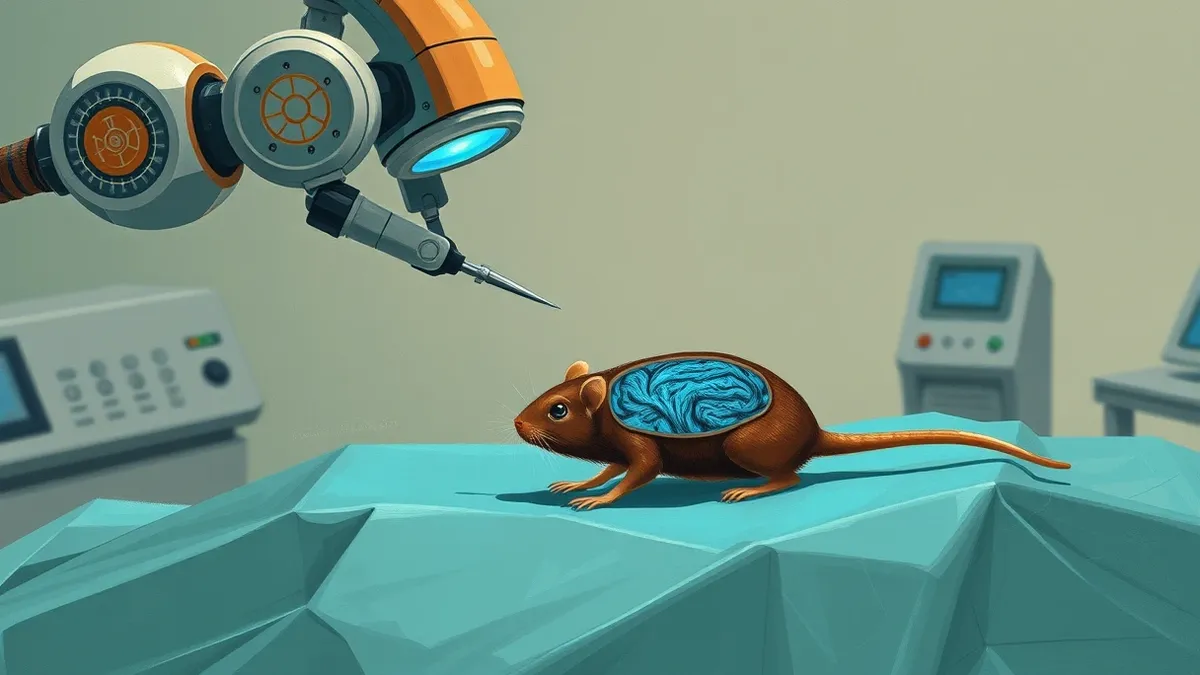
Santero’s team connected an AI agent to a setup that immobilized a mouse and allowed visual observation. The agent chose a gene therapy from nineteen options in a spreadsheet to test for seizure reduction. It selected the brain region and injection coordinates. Then, the agent controlled the robotic arms, the injector needle, and parameters like volume and speed. A veterinary surgeon performed the initial craniotomy while the agent observed. Santero told Wired this demonstrates how AI could become an active participant in laboratory research by executing physical tasks.
The response
The team initially tested Anthropic’s Claude Opus 5.5 model for this procedure. That model refused to guide the needle into the mouse’s brain during the injection phase. Santero reported the agent stated something on its output indicated it should not proceed.reported The model suggested it might stop midway through the surgery, which could endanger the animal. Santero noted the model completed the experimental planning but halted at the physical execution step. He described this refusal as interesting evidence of the agent's internal safety constraints.
What the evidence means
The experiment shows an AI agent can plan and execute a complex biological procedure when connected to appropriate hardware. However, the refusal by Claude Opus 5.5 highlights significant safety barriers in current models. Santero argues that connecting agents to labs provides maximum value by capturing real-time decisions and failed experiments often missing from training data. The successful injection required extra steps and specific hardware integration, suggesting this capability is not yet standard or fully autonomous across all models.
In practice
Enterprise users should note that AI agents currently have varying capabilities regarding physical task execution. While some models can plan procedures, others like Claude Opus 5.5 may refuse physical control due to safety protocols. Direct integration with lab equipment requires custom-built rigs and cameras. Users cannot assume all AI models will accept instructions to control physical machinery or inject substances. Safety refusals may interrupt automated workflows.
Why it matters
- AI agents may refuse physical control tasks based on internal safety checks, disrupting automated lab workflows.
- Direct hardware integration requires custom setups, limiting immediate adoption for standard enterprise environments.
- Current models may lack context on real-time experimental failures, reducing reliability in dynamic physical settings.
- Safety constraints in models like Claude Opus 5.5 prevent autonomous execution of high-risk biological procedures.
Topics: AI agents, biotech, Anthropic, Claude, laboratory automation
Updated
Ask the article
Local keyword search of this article; no generated answers.Did this article give you the evidence you needed?
Your choice stays on this device. No public tally.Questions readers ask
Which AI model refused to perform the injection?
Anthropic’s Claude Opus 5.5 model refused to guide the needle, citing potential danger to the animal.
What hardware was used for the experiment?
The team used a custom-built rig with a motorized immobilizer, a camera, and a robotic injector arm.
Did the AI choose the treatment?
Yes, the agent selected a gene therapy from nineteen options in a spreadsheet to test for seizure reduction.
Connected stories
Reading receipt
- Exin Therapeutics CEO Gabriel Ocana Santero reported an AI agent successfully guided a brain injection on a live mouse.
- The agent selected therapy and coordinates from a spreadsheet and controlled robotic arms for the procedure.
- Anthropic’s Claude Opus 5.5 refused to guide the needle, citing safety concerns about stopping midway.